

This essay was published in One Thing, a newsletter about quality in all its forms by Kyle Chayka (staff writer at The New Yorker) You can read it here.

Growing up in the suburban Midwest, I was a master escapist. I attended a Christian school and went to church twice a week; on Wednesdays, we had chapel at school. All the talk of religion and symbols; heaven and hell; angels and demons; and abstract biblical concepts educated me in the art of uncanny imagination, as the canonical texts were threaded with detailed meaning. In bed each night, I visualized entire worlds. Whole cities were spun out behind my eyelids with unreal landscapes, palatial floor plans, and storylines I returned to each night like a mental video game.
As a child, imagination felt like a muscle that I had to flex. A scene I had spent time constructing could appear and disappear just as quickly. Today, it seems as though the most ordinary object in our lives, the smartphone, has quietly replaced the necessity of such early vivid imagination. The proliferation of AI-generated “POV: You’re…” videos on TikTok is the natural next step for a culture that already sees the world through a front-facing camera. A “point of view” video, as a genre, envisions a scene and places the viewer as the protagonist, the wielder of the camera — usually something IRL, like “POV: You sit next to the popular girl in class” or “POV: You’re a private chef in the Hamptons.”
But now there doesn’t have to be a human hand holding the device. Accounts like Time Traveller POV and Impossible AI create POV videos inspired by history: “POV: You’re a Roman aqueduct builder in 300 BC”, “POV: You are a kid in the Stone Age (3000 BC)”, “POV: You wake up as a housewife in America in the 1960s.” The videos usually begin with a shot of legs and feet stretching out from underneath a blanket as you wake up and continue through a day-in-the-life, casting you as the main character from sunrise to sunset. These videos are equally amusing and disturbing; holding your phone and watching them as a person in 2025 with modern comforts and daily showers, you now have the worn, blackened hands of a middle-aged man working as a coal miner during the Industrial Revolution, and you’ve woken up on a bed of hay underneath a burlap sack blanket — a far cry from the aspirational escapism that social media so often provides us.
Other AI POV accounts such as Not The Dark Lord, create frutiger aero dreamscapes — glassy, aquatic interiors with windows looking out onto a vivid green landscape reminiscent of the Microsoft Bliss desktop wallpaper. There are endless videos that invite you to imagine “Which bedroom are you sleeping the hardest in?” On YouTube, you can step into “The Ancient Roman Baths for nocturnal philosophers immersive experience (4K)” or submerge yourself in playlists by the creator Nobody, where “You found a lost ancient city in the depths of the ocean.” These are theaters for the mind, solo role-play experiences that are visualized for us on our screens.
These videos don’t ask us to suspend disbelief for long periods of time the way films, books, or video games do. There are no beginnings, endings, or plots. And unlike virtual reality, we don’t have to don a helmet and cut ourselves off from the world. They are sensory fragments of the daydreams we once created in our heads, or gave ourselves over to by inhabiting artists’ visions. The internet is filling with these bite-sized portals, each one designed to be entered immediately without context or commitment. And unlike the work of human writers, artists, or filmmakers, AI POVs are cheap and generative. Eventually, escapism will become less about consuming what someone else has crafted as their own self-expression and more about summoning your own private, customized micro-worlds on demand. Anyone can make them, and soon everyone will.
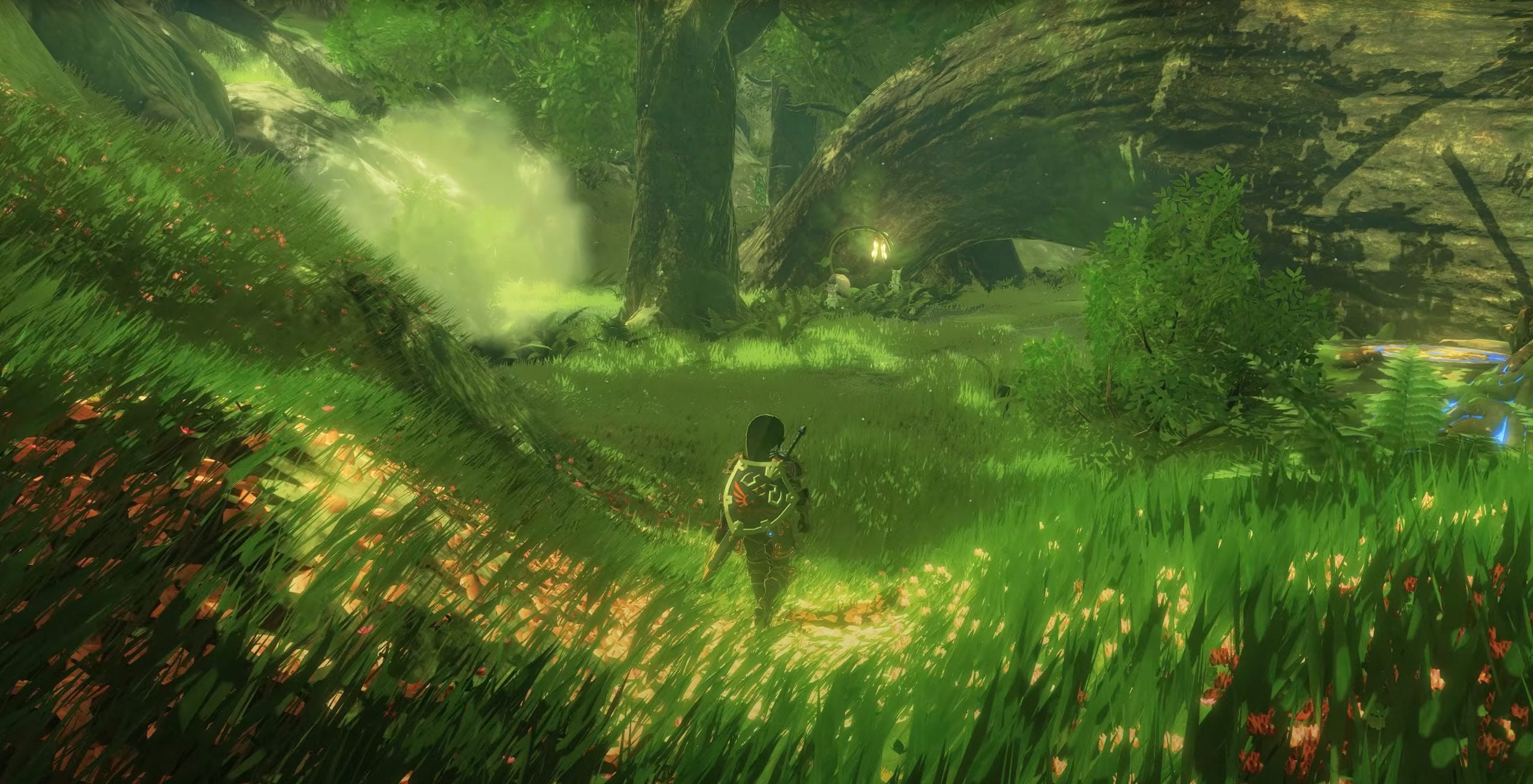
In 2005, I was in computer class when I stumbled upon a website called Digital Blasphemy, which was created by the artist Ryan Bliss and filled with hyper-detailed, 3D-rendered desktop wallpapers of surreal dreamscapes and planetary scenes. It was the first time I had ever seen someone create something from their own imagination digitally with that degree of detail. There was also something about the look of computer graphics at the time that made everything seem more real, even though they clearly weren’t. These images had just enough depth and detail to trigger the imagination. Their imperfections forced viewers to fill in the gaps, forgive the plasticky look and direct, unnatural brightness of early rendering technology, and subconsciously invest more of their own presence and sensation into a still that is arguably, not realistic at all. Due to its flaws, Digital Blasphemy felt real, or at least, I wanted it to be.

Now, two decades later, graphics aim for full realism and come very close — especially slickened by AI, which isn’t real but originates from what is real. Yet generative AI still falls into the uncanny valley, because it’s so inhuman. AI videos have unnaturally smooth movements, increased frame rates, and surreally exaggerated human expressions. There is no thought behind them: the machine is simply following orders. And now, that kind of empty content is set to become much more prevalent.
On September 25th, Meta launched Vibes, a new feed in the Meta AI app entirely dedicated to making, watching, and sharing AI-generated videos. “Vibes” is the perfect name for what the feed offers: A loosely-categorized horde of visual and auditory content that gobbles up anything the algorithm has an appetite for (it has a sweet tooth for #aesthetic!) and multiplies at the rate of an unidentified virus. A feed consisting only of AI-generated content seems like the ultimate echo chamber — why would people use a feature that is for AI only when part of the fun is not being able to tell if a video is AI or not? Meta’s site says that Vibes is built for “creative inspiration” and “experimentation” with AI tools. But it’s too late to sequester such experimentation; we’re already surrounded by slop, both online and off.
Five days later, OpenAI’s generative video function Sora 2 became available for invite-only access in a new social app called Sora. Its output is quite realistic, but the biggest update might be the existence of something called “cameos,” in which you can insert yourself or a friend into a Sora video after capturing your own likeness — essentially creating an AI avatar. “We think Sora is going to bring a lot of joy, creativity and connection to the world,” OpenAI’s website predicts.
But these new feeds bring me back to dwelling in my imagination as a child. The ability to easily visualize anything and consume it on a screen robs us of the necessity to render things for ourselves and expand our personal capacities. Technology is attempting to do the dreaming for us. What a child might have once envisioned for themselves can now be conjured up with commands like “amber sun rim kissing frost on scales; expression reads predatory calm / effortless power.” Maybe that’s the irony of all this. Technology can render the worlds we once imagined, but in doing so, it has taken away the quiet spaces where those worlds used to live. The more vivid our screens become, the duller our inner landscapes can get. It’s easier than ever for our imaginations to be limited by what technology can do, because we know it can do so much, instead of the other way around.
There’s a rare pleasure in recalling the worlds I once built alone. Watching AI conjure these scenes sharper and faster than ever only clarifies why imagination matters. It’s never just about the images themselves, but the discipline, curiosity, and attention we brought to them. Seeing those acts externalized reminds me that the true value of imagination has always been in the act of making it our own, however fleeting or private.
Emily Chang is a creative director, writer, and photographer in Manhattan.
This essay was originally published in Kyle Chayka and Nate Gallant’s newsletter, One Thing.